SCAP
Transductive test-time adaptation via supportive clique-based attribute prompting — CVPR 2025
A vision-language model deployed in the wild meets data that does not look like its training set, and accuracy quietly degrades. The usual remedies — labels, retraining — are exactly what you do not have at deployment time. SCAP keeps CLIP-style models accurate under distribution shift with no labels and no retraining (Zhang et al., 2025).
Done at the OV³ Lab, Wangxuan Institute of Computer Technology, Peking University, with Prof. Jiahuan Zhou. Published at CVPR 2025.
The idea
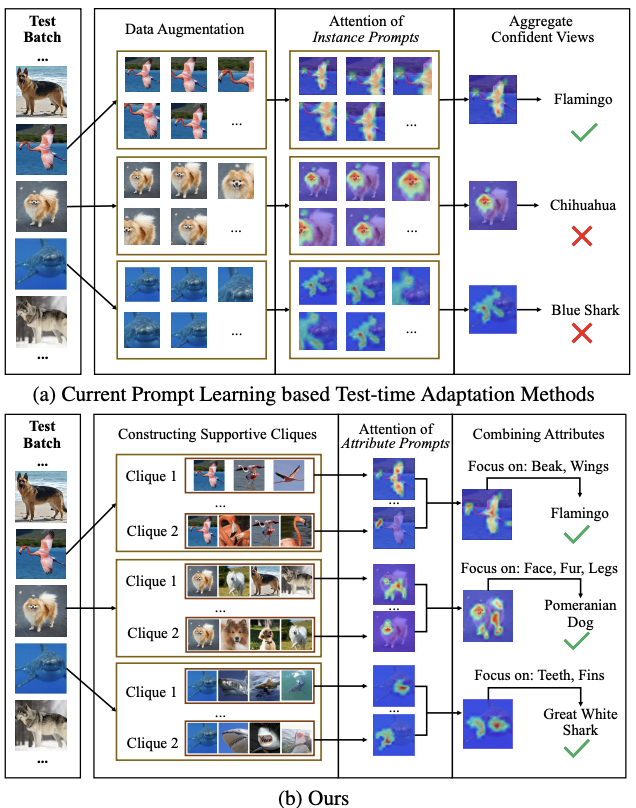
Test samples arrive together, and that is information most test-time adaptation methods throw away by treating each sample in isolation. SCAP is transductive: it finds cliques of visually similar test samples and adapts attribute prompts against the clique rather than the individual. Samples that look alike constrain each other, and the adaptation signal gets correspondingly stronger.
The useful consequence: performance improves as the test batch grows, where per-sample methods flatten out.

References
2025
- CVPR
 SCAP: Transductive Test-Time Adaptation via Supportive Clique-Based Attribute PromptingIn Proceedings of the IEEE/CVF Conference on Computer Vision and Pattern Recognition (CVPR), 2025