RobotArena ∞
Unlimited robot benchmarking via real-to-sim translation — ICLR 2026
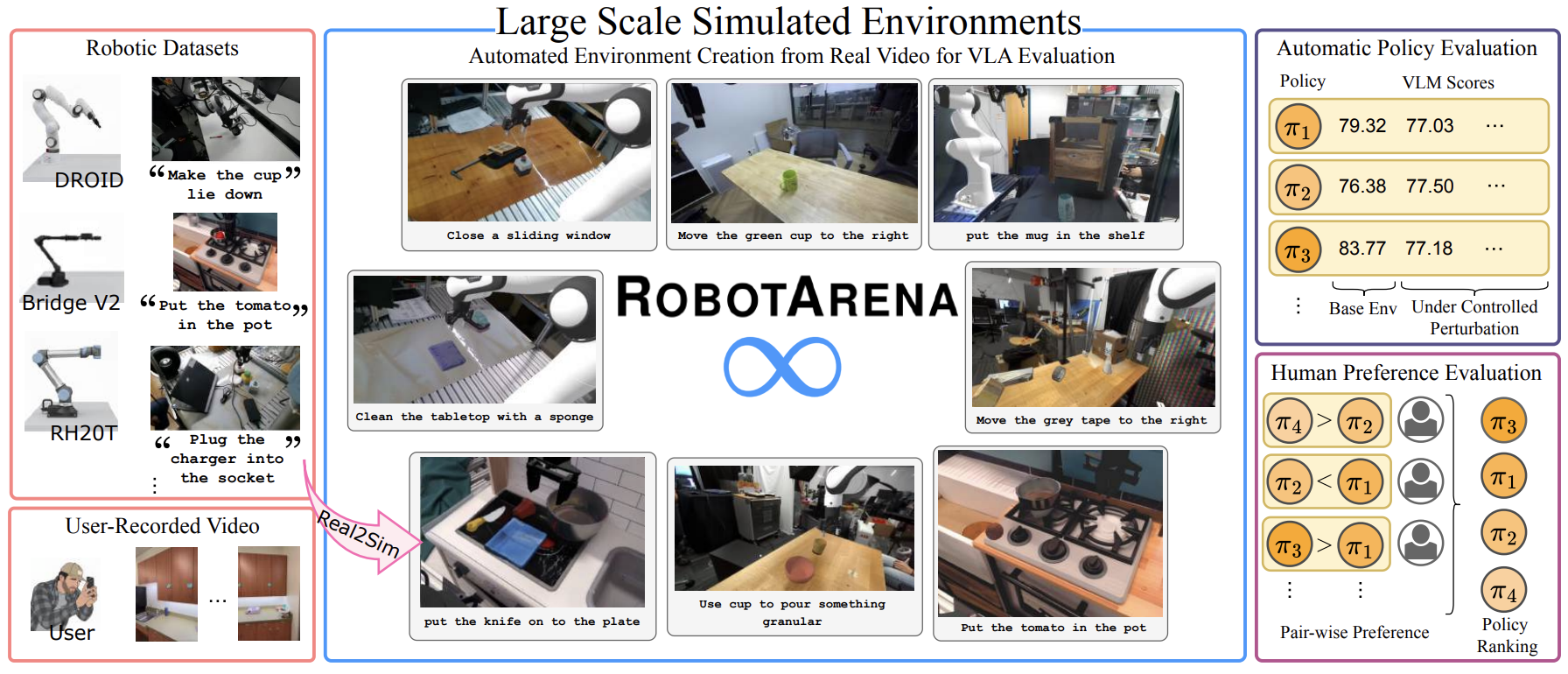
Evaluating a robot policy honestly is expensive. Real-world evaluation does not scale, and hand-authored simulation benchmarks cover a narrow, hand-picked slice of the world. RobotArena ∞ takes a third route: turn the robot video that already exists — millions of teleoperation episodes sitting in public datasets — into physics-consistent simulated environments you can evaluate in, perturb, and re-run without limit.
The work was done at Carnegie Mellon University with Prof. Katerina Fragkiadaki, and was accepted to ICLR 2026 (Jangir et al., 2026).
My contributions
Real-to-sim pipeline. I built the path from a teleoperation video to a simulated environment you can actually run a policy in: generative scene modeling to recover 3D geometry and appearance, and differentiable rendering to make the reconstruction agree with the observed pixels. The output is not a pretty scene — it is a physics-consistent one, with object poses and contacts that hold up when a policy starts interacting with them.
Automatic camera–robot calibration. Calibration is the quiet blocker in real-to-sim: if the camera-to-robot transform is wrong, everything downstream is wrong, and the standard fix is a human with a checkerboard. I designed a calibration method built on 3D Gaussian Splatting that recovers the transform with sub-centimeter pose error and no manual supervision. Running it over BridgeV2, DROID and RH20T produced more than 10,000 calibrated trajectories — the raw material the rest of the pipeline consumes.